Case 03 / Internal tool
Role-Separated Seller Payout Flow for AmMall Bookkeeping
Admin system
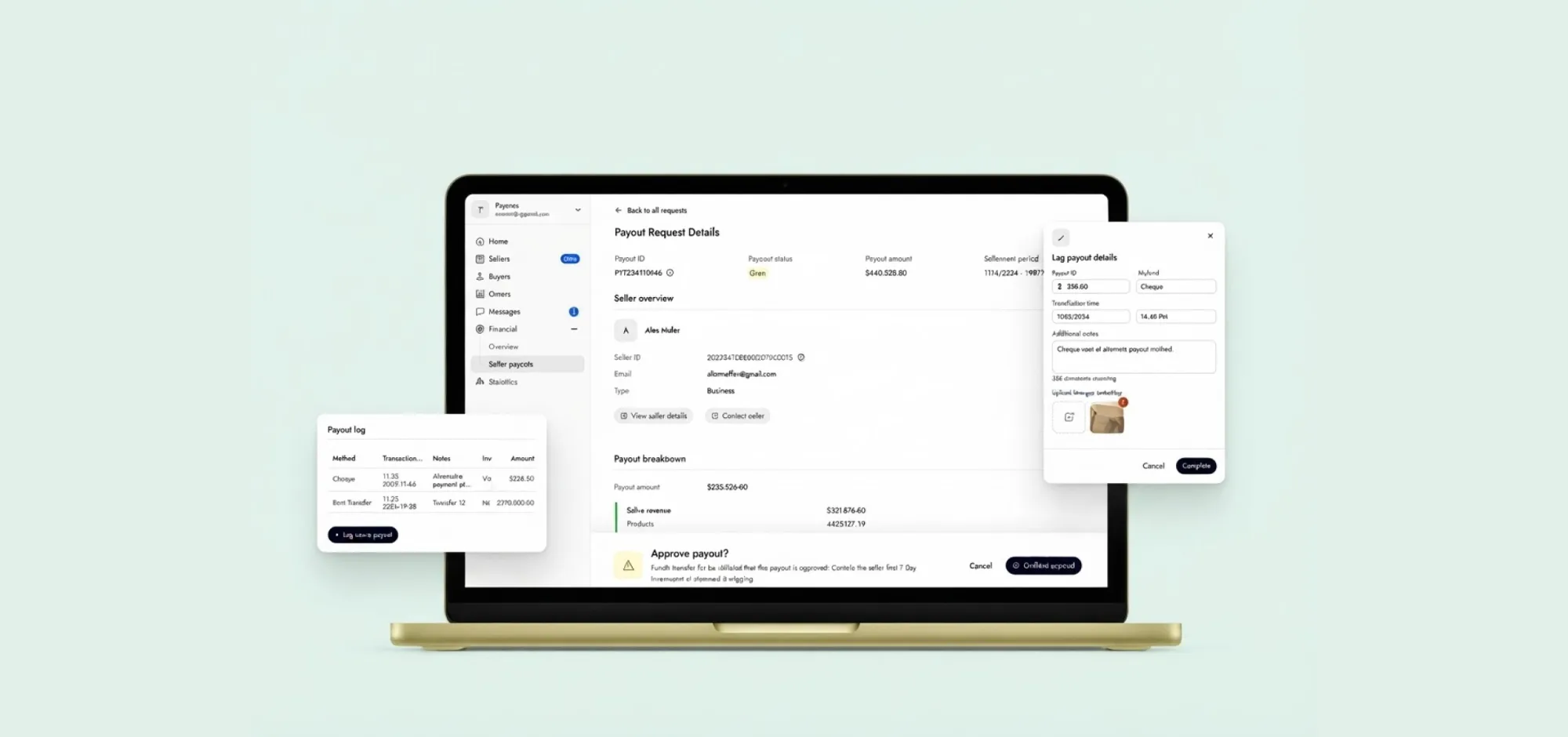
Designing a four-stage payout workflow for the operations team — automating calculation, separating approval and execution, and leaving a clean audit trail behind every transfer.
01 — Context
A marketplace ready to pay sellers, with no system to do it.
Marketplaces collect payments from buyers and later distribute earnings to sellers. As the platform prepared to support seller payouts, the operations team needed a reliable way to calculate payouts, approve payments, and track financial records.
However, no internal system existed to manage this process.
02 — Problem
Without a dedicated system, every payout was a financial risk.
- Payout calculations could not be verified easily.
- Payment records were difficult to track.
- Financial oversight across roles was unclear.
This created potential operational risk and financial control issues.
03 — Research
Four insights from finance & treasury practice.
With limited resources, I conducted qualitative research with three participants (from treasury staff to finance director), and secondary research on financial statements and bookkeeping to understand how money actually moves inside an operating team before designing a system finance professionals would trust.
- 3 semi-structured interviews (treasury staff, finance manager, finance director)
- Desk research on financial statements, internal controls, and audit trails
- Synthesized into the four insights below
01Financial workflows rely on role separation
"Treasury executes payments, while approval is handled by other financial roles."
Implication — Approval, payment execution, and financial review should be handled by different roles.
02Payments must leave a clear record
"Treasury records transaction details such as name, date, amount, and payment status."
Implication — The system should include payment logs and proof of payment.
03Different roles need different financial views
"Finance staff verify transaction accuracy, while leadership focuses on cash flow and risks."
Implication — The system should support both detailed transaction views and summary dashboards.
04Financial systems must scale with transaction volume
"With large transaction volumes, systems store detailed records while reports show summarized totals."
Implication — Automate payout calculations while allowing drill-down into transaction details.
04 — Goals
01Business goal
Ensure seller payouts follow clear financial control and audit requirements.
02User goal
Allow finance teams to verify payouts, execute payments, and review records in a clear workflow.
Approve
- Verify payout accuracy
- Approve payout requests
Execute
- Send payments through bank
- Record payment proof
Reconcile
- Verify financial records
- Reconcile transactions
Monitor
- Track revenue
- Monitor cash flow
03Design goal
Use visual hierarchy for quick scanning and design a clear payout workflow with next-step guidance for each role.
04Development goal
Automate payout calculations and support role-based actions. Ensure backend data matches the financial logic shown in the UI according to product document.
05 — Principles
Transparency
Financial data must be easy to verify.
Traceability
Every payout action must leave a record.
Role separation
Different financial roles should perform different actions.
06 — Solution
A four-stage workflow, end to end.
-
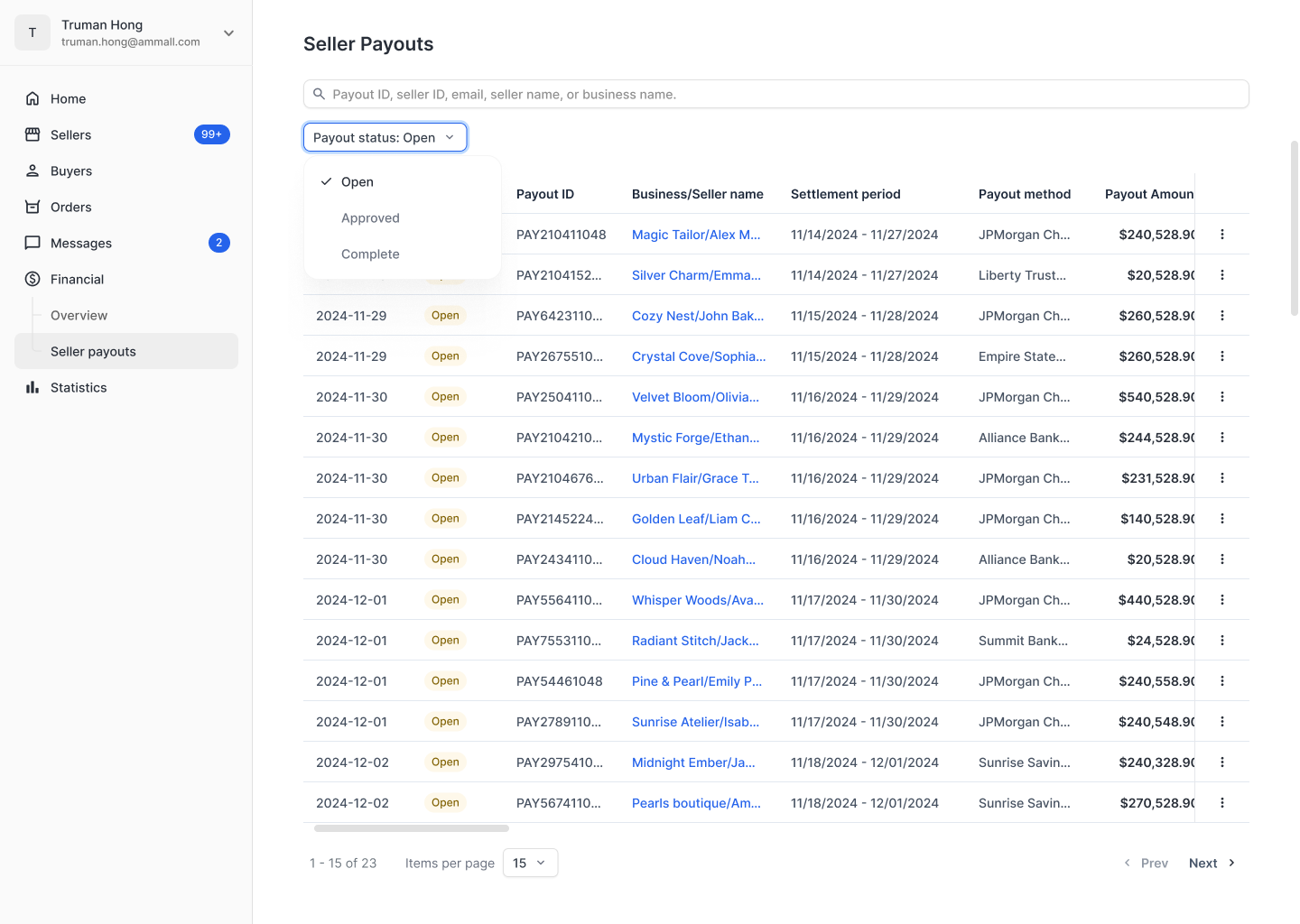
AutomationSystemSystem automatically generates payout batches based on sellers' schedule.
-
AuthorizationManagerManager reviews and approves payouts.
-
ExecutionTreasuryTreasury executes bank transfers and logs payment receipts.
-
OversightAccountantAccountants review financial records and reconciliation.
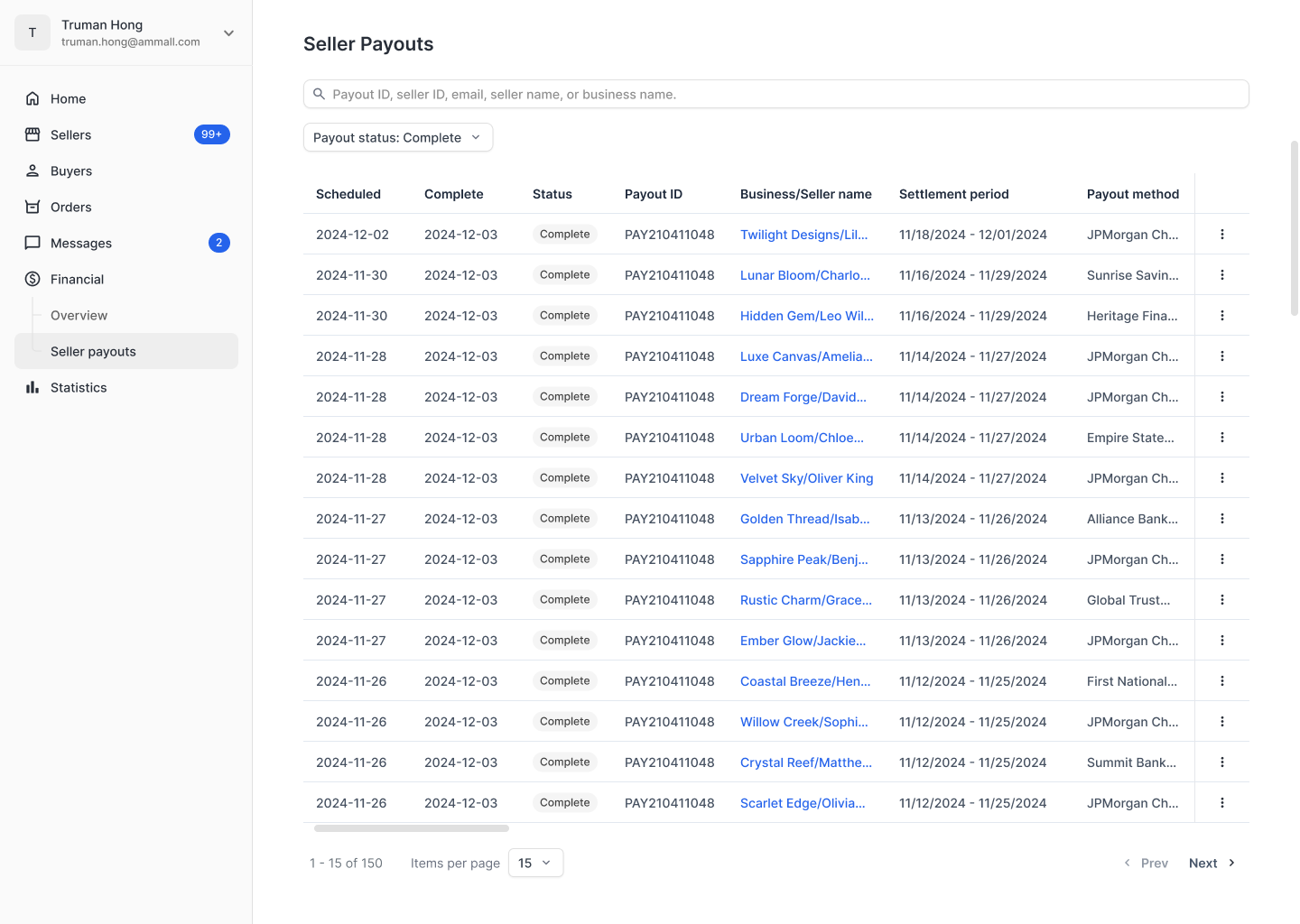
The workflow separates approval, execution, and financial oversight — supporting internal financial controls.
07 — Impact
What the platform can now do.
- Manage seller payouts reliably.
- Maintain financial audit trails for every transaction.
- Provide tailored financial visibility for each role.
08 — Future
Where the system grows next.
01Role-based access control
Due to the current team size, page access permissions are not yet strictly separated. However, the product already defines clear role boundaries (manager, treasury, accountant), allowing role-based access control to be implemented easily as the team grows.
02Payout automation
After validating the workflow, payout approvals can gradually be automated to improve efficiency.
03Scalable financial data management
After discussing with engineers, it is feasible that as transaction volumes increase, detailed transaction records can be archived while summary-level views remain accessible — maintaining both data transparency and system performance.
Designing financial systems is not only about interfaces, but about structuring workflows that reduce risk, support accountability, and scale with the business.