Case 04 / DTC · Product Page
Closing the Gap Between Intent and Purchase
A data-driven redesign of a motorcycle gear brand's product detail page — built to convert the street-riding customer who already wants the gear, but stops just before buying.
01 — Context
Street gear with a clear point of view.
The client sells motorcycle gear to riders who refuse to choose between looking good on the street and staying protected on the bike. The brand's positioning is sharply defined: the "Street-First" Aesthetic — gear that passes as premium urban streetwear until the moment it needs to absorb an impact.
The store already had working traffic, strong brand identity, and a ~$300–320 USD average order value. The brief wasn't about attracting new visitors — it was about converting the ones already arriving with intent.
"The positioning is already working. We need to stop the PDP from getting in its own way."
02 — Research
Listening to buyers and browsers.
Research drew from three sources: a five-question post-purchase survey (n=305 over 30 days), Microsoft Clarity session recordings focused on desktop behaviour, and a heuristic audit of the live PDP.
Q1 — Why did you buy?
7% Brand Identity · 6% Value for Money · ···
The aesthetic is the product. Two thirds of buyers purchased because of how the gear looks — yet the PDP's visual experience was underselling it.
Q2 — What almost stopped you?
10% Material/Safety Uncertainty · 7% Brand Credibility · ···
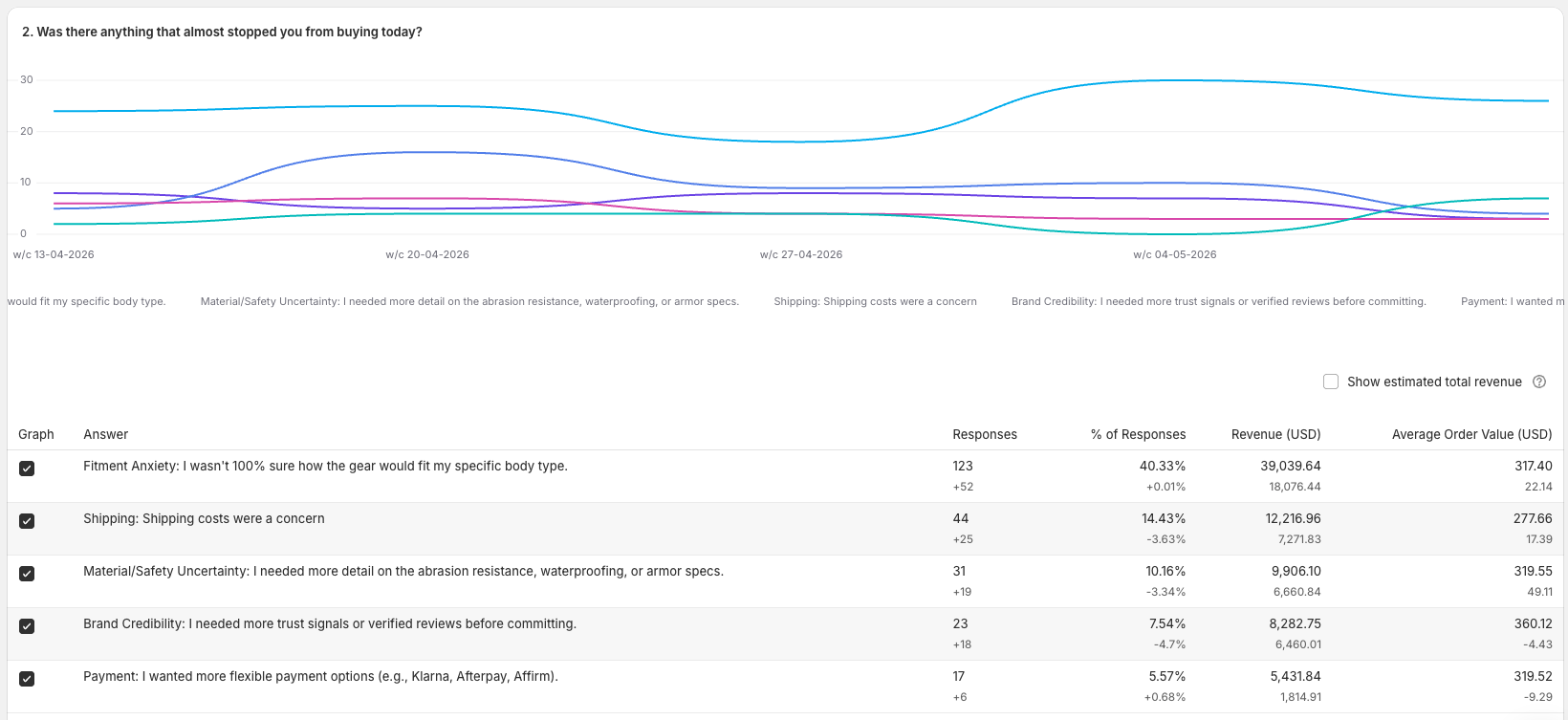
Fitment anxiety alone affected 4 in 10 buyers who converted. The rate among those who abandoned is almost certainly higher.
Q3 — What would help you decide faster?
Session recordings — Microsoft Clarity
Desktop sessions revealed a consistent pattern: images spaced across a long single-column scroll caused users to repeatedly scroll past content and backtrack searching for size charts and spec callouts. Multiple sessions showed abandonment mid-scroll. The scroll journey was eroding confidence rather than building it.
03 — Findings
Problems costing conversions.
Problem 01
Gallery kills momentum on desktop.
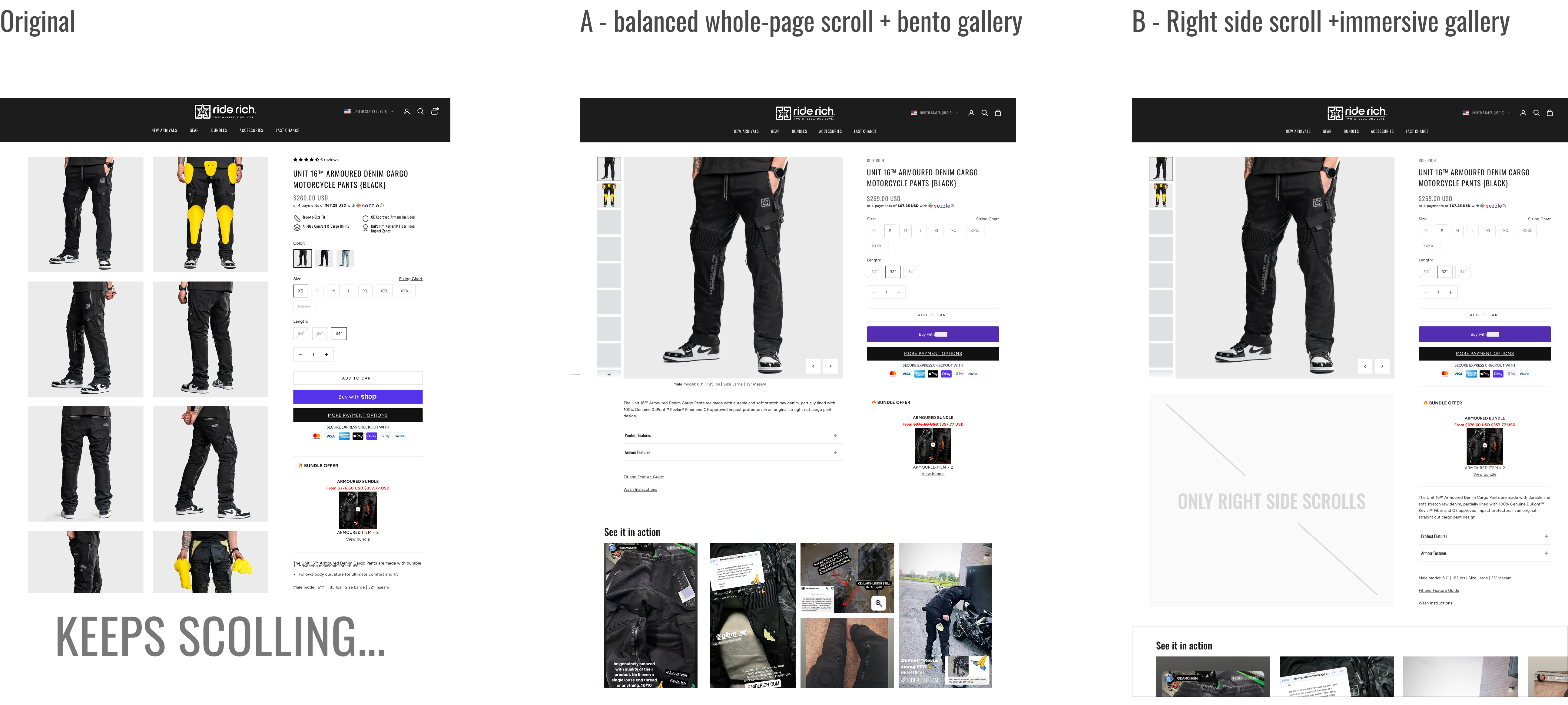
Images scattered down the page forces users to scroll to see all images, which will scroll away the buy box. Many don't return to convert.
Problem 02
No real-world proof.
The top purchase driver is the aesthetic, yet the PDP has no video and no lifestyle footage. The "See it in Action" content that 22% of buyers asked for is completely absent.
Problem 03
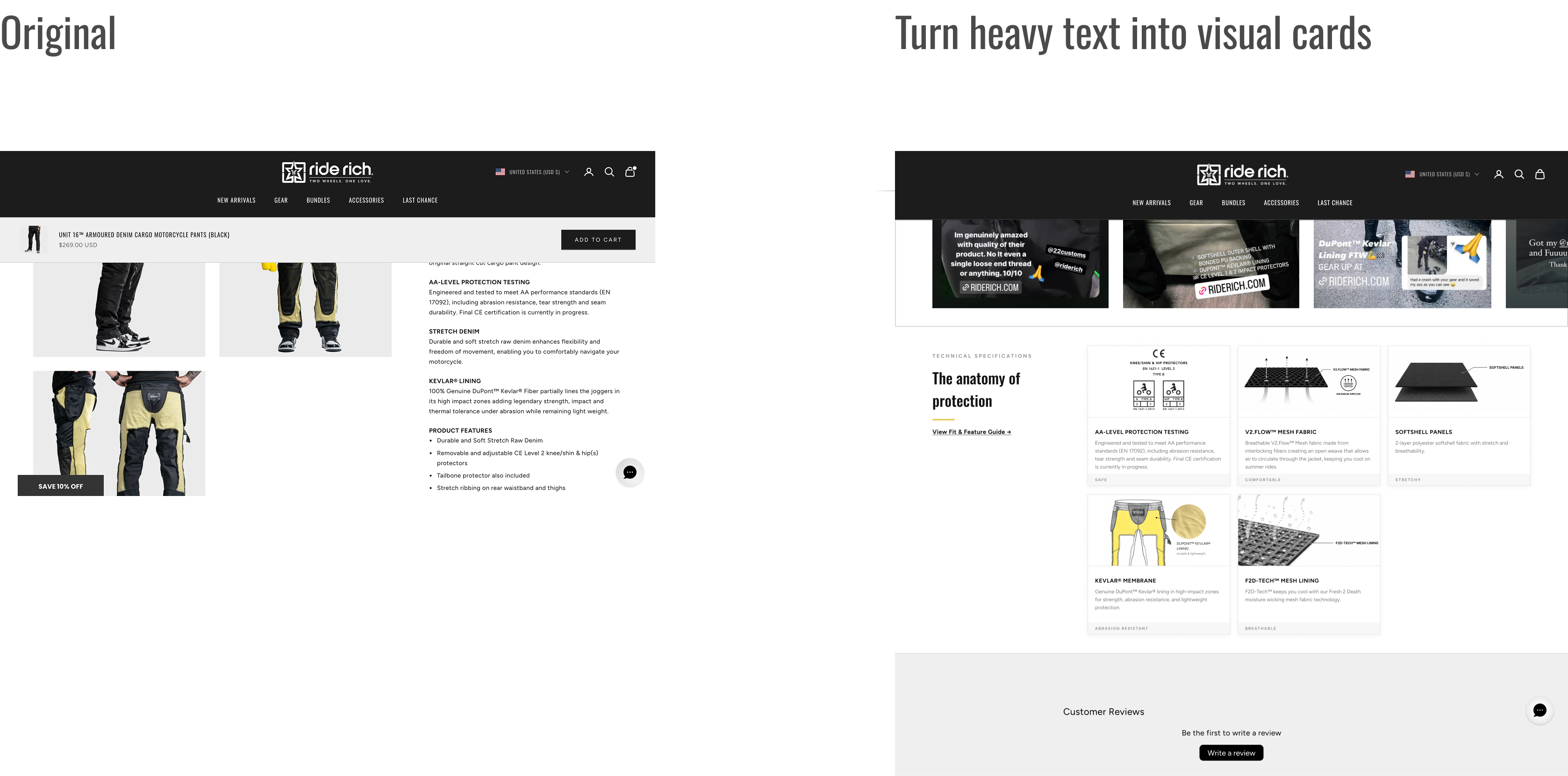
Specs buried in prose.
Armour ratings, lining fabric, and waterproofing specs are presented as paragraph text. However, these info does not facilitate understanding.
Problem 04
Sizing is a trust problem.
The current size selector is a row of letter buttons with a static chart link, with lines of numbers. Yet fitment anxiety is the single biggest hesitation in the journey for a lack of better guidance.
04 — Solutions
Redesigning sections in the PDP.
Solution 01
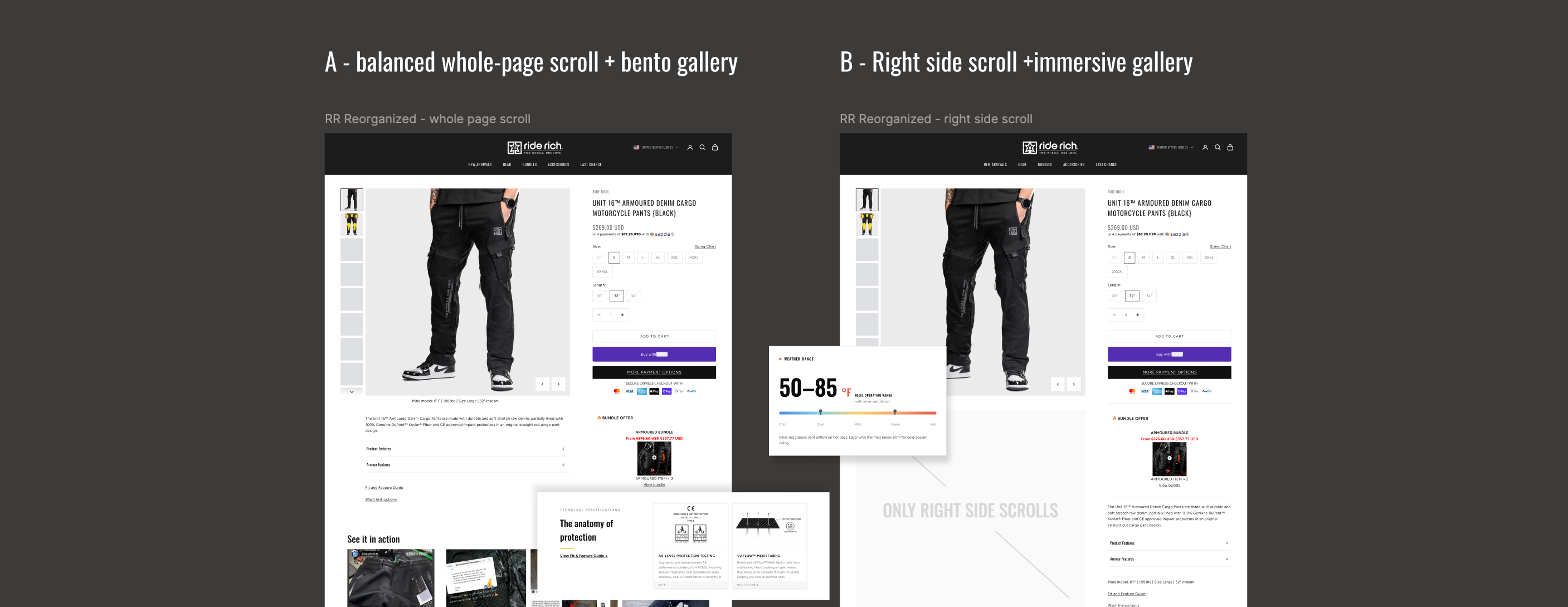
Right-column scroll. Let images take the stage.
- Problem
- Images scattered down the page forces users to scroll to see all images, which will scroll away the buy box.
- DESIGN SOLUTION
- The PDP moves to a two-column layout where product information scrolls on the right and the image gallery sticks on the left. The buy box — price, size selector, add-to-cart — stays visible at all times while the customer browses images.
- ALTERNATIVE FULL-PAGE SCROLL
- We decided to discard our backup plan of full-page scroll because A. content on both sides creates competing visual attention; B. the buy box exits viewport too early. Right-side scroll gives each image the full left half of the viewport as a dedicated stage — maximizing the visual impact of an aesthetic-first product.
Solution 02
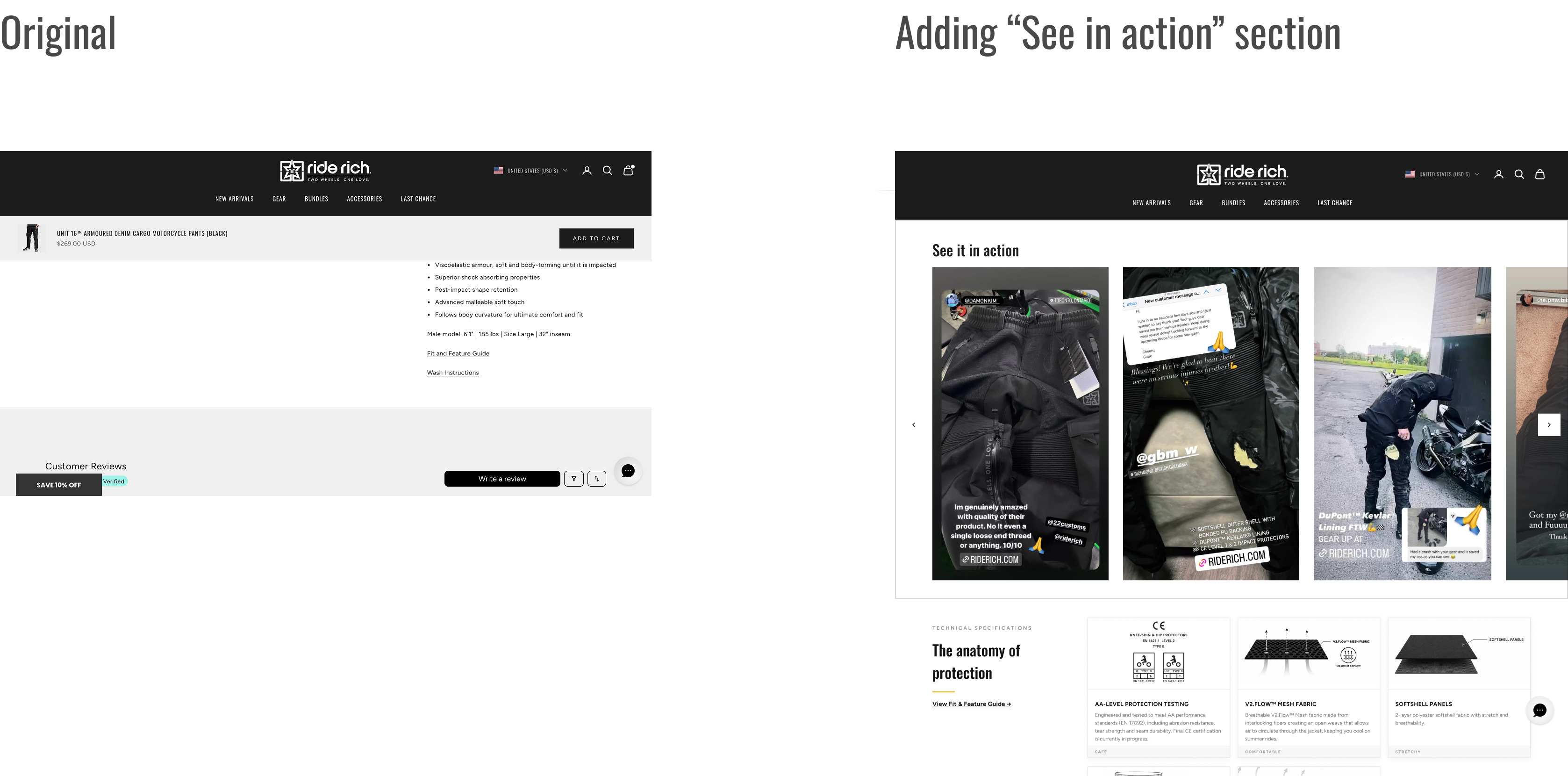
Add "See It in Action" to embed real-world content.
- Problem
- 22% of buyers wanted real-world footage; 39% wanted verified fit content from real customers. These sections either doesn't exist, or exists early enough on the current PDP.
- DESIGN SOLUTION
- A dedicated "See It in Action" module added right after the buy box/image section.
- Outcome
- Closes the gap between the brand's social presence (which performs well) and a PDP that was sterile by comparison.
Solution 03
Visualize specs to make them scannable.
- Problem
- Technical specs are a purchase driver (15%) and a hesitation (10%). Dense paragraph text hides the value proposition.
- DESIGN SOLUTION
- Replaced text-heavy accordion with a scannable spec display: used illustration and diagram specifically made for this product, and reduced length of text. These trust signals anchors the value proposition.
Solution 04
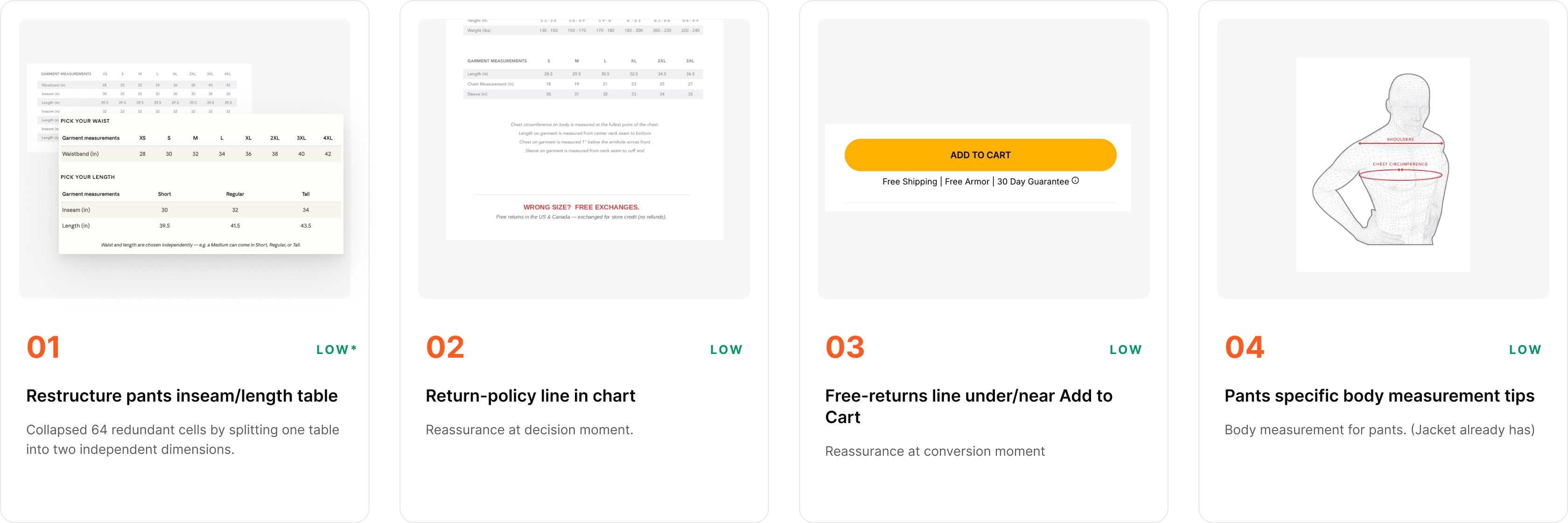
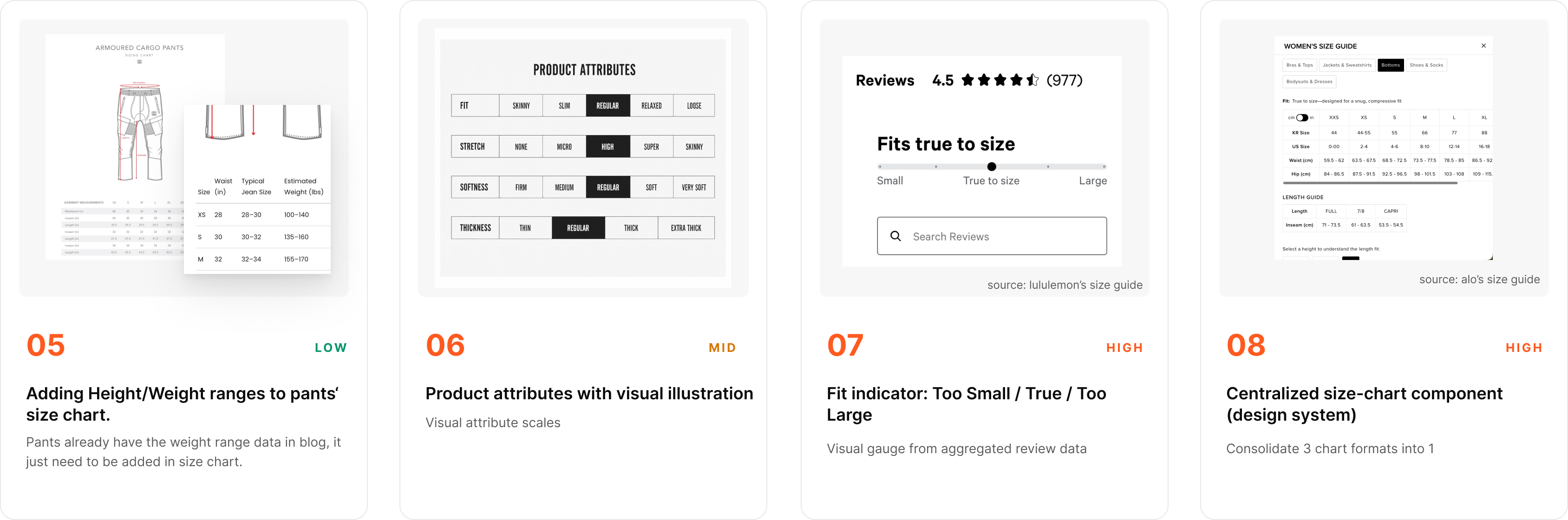
A better sizing experience — reduce fitment anxiety.
- Problem
- 40% of buyers cited fitment anxiety as their biggest hesitation.
- Design Solution
- Suggested changes while considering their impact and effort:
Restructured the sizing table, added body measurement guidance, and surfaced trust signals like free exchanges, fit indicators, and body-specific measurement tips, etc.
05 — Summary
Data leads. Testing confirms.
The brand already has what it needs to convert: a distinct aesthetic identity, strong community, and competitive pricing. Every design decision here was driven by post-purchase survey data. The Street-First Aesthetic drives 66% of sales, so the gallery needed to be a stage for it. Fitment anxiety almost blocked 40% of buyers, so sizing had to become a trust-building moment. Specs cost conversions, so they needed to be scannable and visible.
None of big changes should launch without being measured or A/B tested.
Buy box button hierarchy needs clearer visual priority. "Add to Cart" and "Buy with Shop Pay" currently compete equally.
Customer-submitted size evaluations surfaced contextually near the size picker to address fitment anxiety at the moment of decision.
A fit recommender (enter height, weight, and preferred fit) to directly target the 40% fitment anxiety finding for first-time buyers.
The survey and screen recordings should keep running. It is the most direct feedback loop from customer intent to page design.
